
Roller Chain Selection for Corrosive Environments in the Chemical Industry
The chemical industry commonly experiences complex corrosion from acids, alkalis, salt spray, water vapor, chemical solvents, and high temperatures. Ordinary carbon steel chains are prone to rust, fatigue, and breakage, directly impacting continuous equipment operation and maintenance costs. Targeting global chemical wholesale procurement and project support, this article provides practical roller chain selection solutions from the perspectives of corrosion level, material, standards, structure, lubrication, and maintenance. This helps purchasers accurately match operating conditions, ensure stable supply, and reduce total lifecycle costs.
I. First, Clarify: Chemical Corrosion Environment Classification and Core Selection Prerequisites
The corrosion intensity varies greatly in chemical scenarios. Determining the environment first, and then narrowing down the material and specifications, is the first step to efficient chain selection.
1. Corrosion Environment Classification (Internationally Accepted)
Weak Corrosion: Dry workshops, slight moisture, no direct chemical contact
Medium Corrosion: Humidity, condensation, weak acid/alkali spray, general cleaning conditions
Strong Corrosion: Acid mist/alkali mist, chloride ions, salt spray, organic solvents, continuous immersion
High Temperature Corrosion: ≥150℃ with corrosive media, commonly found in reactors, drying lines, and heat treatment sections
2. Four Essential Parameters for Selection
Transmission/Conveying Applications: Short-pitch precision roller chains are preferred for power transmission; double-pitch conveyor chains are preferred for long-distance material conveying.
Standard Systems: ANSI (American Standard), ISO 606, DIN (European Standard); chains and sprockets on the same production line must conform to the same standard.
Load and Speed: Rated load × 2–3 times the safety factor; lubrication and structure differ between high-speed light load and low-speed heavy load.
Temperature Range: -20℃~400℃ is the commonly used range. Special heat-resistant stainless steel is required for 400℃ applications.
II. Material Selection: A Core Decision for Chemical Corrosion Conditions
The material directly determines corrosion resistance, lifespan, and cost. International procurement prioritizes materials selected based on corrosion intensity.
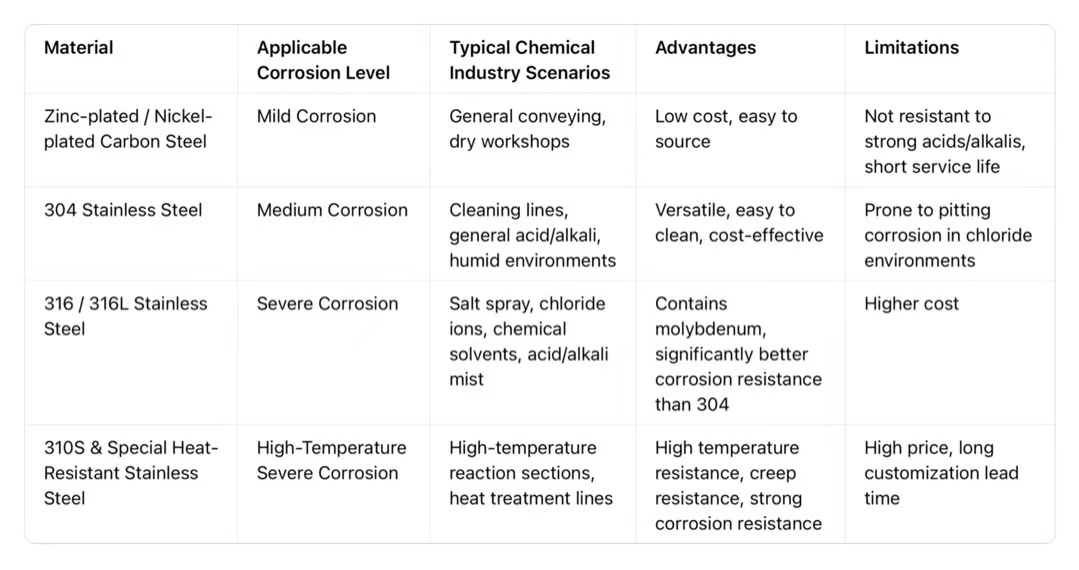
Selection Conclusion (Internationally Applicable)
90% Corrosive Conditions in Chemical Industries: 304 Stainless Steel Roller Chain
Salt Spray, Chloride Ions, Harsh Chemical Media: 316/316L Stainless Steel Roller Chain
High Temperature + Corrosion Complex: 310S or Special Heat- and Corrosion-Resistant Alloy Chain
III. Structure and Specifications: Key Details for Adapting to Chemical Production Lines
1. Chain Type Selection
Short Pitch Precision Roller Chain (A Series / 08B / 12B, etc.): Power transmission for chemical machinery, high precision, stable meshing
Double Pitch Conveyor Chain: Long-distance, light to medium-load material conveying, lower cost, easier installation
Single Row / Double Row / Multi Row: Double row/multi row preferred for heavy loads, distributing load and improving fatigue life
2. Key Structural Optimization (Chemical Specific)
Chain Plates: Cold-rolled hardened + precise hole positions, reducing gap contamination and media retention
Pin Shafts / Sleeves: Precision fit reduces wear and corrosion intrusion.
Surface Treatment: Electrolytic polishing and anti-corrosion coating reduce roughness and minimize adhesion and corrosion.
Accessories: Scrapers, bend plates, and extended pins are available upon request to meet customized needs for chemical conveyor lines.
3. Quick Reference for International Standard Models (Commonly Used in Chemical Industry)
ANSI: 40, 50, 60 series stainless steel roller chains
DIN/ISO: 08B, 12B, 16B series stainless steel roller chains
Single-row, double-row, and non-standard customization are all supported to meet global equipment matching needs.
IV. Lubrication and Protection: Extending Chain Life in Corrosive Environments
Under corrosive chemical conditions, proper lubrication can increase chain life by more than 50%. International procurement requires simultaneous determination of lubrication solutions.
Lubricant Selection
Corrosion-resistant conditions: Chlorine-free and sulfur-free synthetic lubricants to avoid reaction with the medium.
High-temperature conditions: High-temperature resistant long-life grease/synthetic oil.
Clean/food-related chemicals: NSF H1 food-grade lubrication solution.
Lubrication methods
Low speed, heavy load: High viscosity oil (ISO VG 150–220).
High speed, light load: Low viscosity oil (ISO VG 68–100).
Enclosed/dusty environments: Semi-fluid grease with strong adhesion and low leakage.
Corrosion Protection Points
Regularly clean chain link gaps to remove chemical residues. Protective covers can be added to highly corrosive areas to reduce spraying and direct exposure.
Stainless steel chains are not maintenance-free; regular lubrication and friction reduction are still necessary under heavy loads.
V. Key Points for Avoiding Pitfalls in International Procurement
Avoid blindly choosing the lowest price: Ordinary carbon steel chains fail within 3–6 months in corrosive chemical environments, resulting in a significantly higher total cost than stainless steel chains.
Standardized specifications: ANSI and DIN chains of the same specification have similar dimensions but are not interchangeable; chain and pulley must be procured according to the same standard.
Complete qualifications: Prioritize chains conforming to ISO, ANSI, and DIN standards. Standard suppliers providing material reports and fatigue tests are preferred.
Customization requirements: Special pitches, chain plate thicknesses, and accessories must be confirmed in advance to ensure delivery time and compatibility.
Safety factor: For corrosion and fluctuating loads, the safety factor should be no less than 2.5 times to avoid fatigue fracture risks.
VI. Summary: Simplified selection process for roller chains in chemical corrosion conditions
Determine corrosion level and temperature → Select 304/316 / special heat-resistant materials
Determine transmission/conveying application → Select short-pitch precision chains or double-pitch conveyor chains
Check ANSI/ISO/DIN standards → Match single-row/double-row/multi-row specifications
Clarify load and speed → Calculate safety factor and lubrication scheme
Consider line requirements → Customize accessories and surface treatment
Post time: Mar-18-2026