
Roller Chain Lubrication Methods and Relubrication Intervals
For industrial buyers who source chain drives in volume, lubrication is one of the least visible line items in the budget and one of the most expensive habits to get wrong. A chain that is installed correctly on well-matched sprockets and then run dry will lose its service life far faster than the same product lubricated on a disciplined schedule. Yet the reverse is also true: over-lubrication shortens life, contaminates product, and creates housekeeping problems that plant managers notice long before they notice chain wear. The purpose of this guide is to give procurement and maintenance teams a working framework for deciding where lubricant belongs, how it should be delivered, what grade to specify, how often to renew it, and how to build that routine into a spare parts and downtime plan that a factory can actually execute.
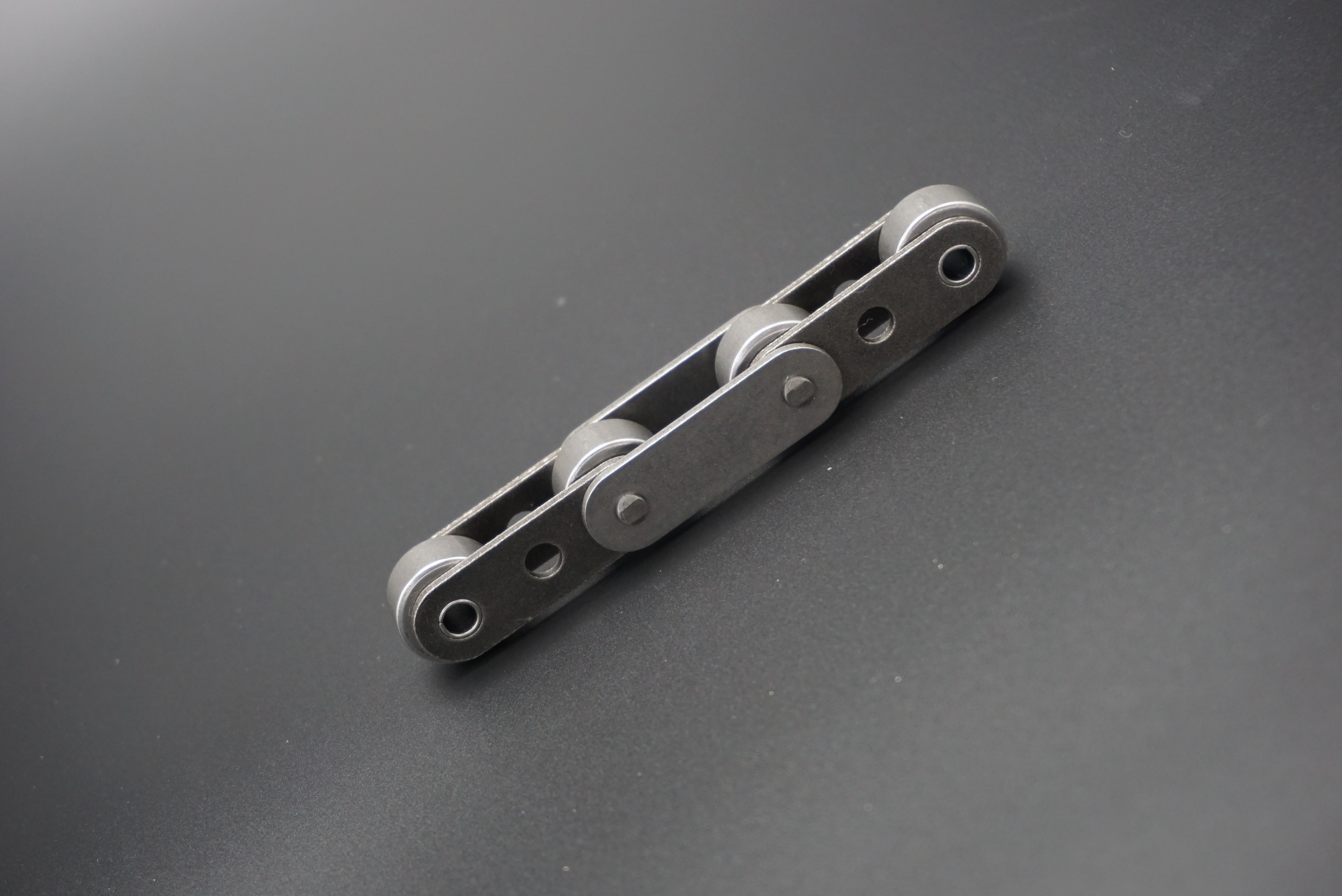
Where Lubrication Actually Happens: The Pin and Bushing Interface
The most common misconception in chain maintenance is that oil belongs on the outside of the chain. A roller chain is not a cable or a gear tooth that needs surface film. It is a series of pin and bushing joints, and each of those joints is a small bearing that articulates every time the chain wraps onto and off a sprocket. The wear that destroys a chain happens inside that clearance, between the pin surface and the bore of the bushing, under load and under oscillating motion.
Every part visible from the outside of the chain has a job, but none of them is the primary lubrication target. The roller rotates around the bushing to convert sliding contact with the sprocket tooth into rolling contact. The side plates carry the tensile load and hold the assembly together. If you brush oil onto the outside surfaces of the link plates and walk away, the majority of that oil never reaches the clearance where friction is generated. It sits on the plates, attracts dust, and eventually flings off.
For a lubricant to do its job it has to be drawn into the joint by capillary action. The annular clearance between pin and bushing is small enough that a fluid with suitable wetting behaviour will migrate along it, especially when the joint articulates and momentarily opens a slightly larger gap on one side. This is why application method matters almost as much as oil selection. A heavy, high-viscosity product that cannot creep into that gap will perform poorly even if it looks impressive on the surface, and a very light product may penetrate well but lack the film strength to survive contact pressure once it gets there.
This also explains why delivery point matters. Lubricant should be applied at the slack side of the drive, near the point where the chain leaves the small sprocket, because joint articulation and the brief pressure change there help draw fluid inward. Applying it where tension is highest tends to leave it on the outer surfaces.
Factory Pre-Lubrication: Ready to Run, but Not Protected Forever
A quality chain arrives from the factory already lubricated. This initial lubrication step is not cosmetic. It is performed after assembly, usually by dipping the finished chain in heated oil so that the fluid is thin enough to penetrate the joint clearance, then draining and sometimes centrifuging off excess so the product ships clean to handle.
For a buyer, several practical consequences follow. First, the chain genuinely is ready to install. There is no need to strip, wash, or soak a new chain before putting it into service, and doing so can actually remove lubricant that had already migrated into the joints. Second, that factory film is a protective measure for storage and start-up, not a lifetime supply. It protects against corrosion during shipping and warehousing, and it supports the first hours of operation, but it will be consumed, flung off, or contaminated well before the chain reaches any meaningful fraction of its potential service life.
Third, storage conditions affect how much of that initial protection survives. Chain kept in a dry indoor store retains factory lubricant reasonably well; chain that has sat in a humid warehouse, been opened and re-wrapped repeatedly, or been exposed to salt air may be partially starved even before commissioning. When you stage inventory for a project, keep it wrapped, off the floor, and in a stable environment, then plan the first field lubrication early in the commissioning process rather than waiting for the first scheduled service window.
Comparing Lubrication Methods
There is no universally correct method. The right choice depends on line speed, duty cycle, ambient conditions, accessibility of the drive, and how much supervision the maintenance team can realistically provide. The following list summarises the practical boundaries of each approach.
Method Selection Checklist
- Manual brush or oil can: Suitable for low-speed, lightly loaded, easily accessed drives and small installations. Low capital cost but entirely dependent on operator discipline. Best where the number of drives is small and the route is walked daily.
- Drip or drop feed: A simple reservoir feeding individual drops onto the chain. Better consistency than brushing, modest cost, but the feed rate is sensitive to oil viscosity and temperature, so it drifts across seasons unless readjusted. Suitable for moderate speeds.
- Oil bath: The chain dips into a reservoir carried in an enclosed housing. Excellent lubrication and some cooling, but it requires a casing, correct fill level, sealing, and periodic oil change. Only applicable where the drive can realistically be enclosed and the chain cannot be allowed to run at excessive bath temperature.
- Oil circulating system: Pump, filter, and reservoir feeding the chain continuously, often with cooling. Appropriate for high-power and high-speed drives, multiple drives fed from one system, or hot environments. Higher capital and filtration cost, justified where downtime is expensive.
- Air-oil or mist systems: A metered mixture of air and oil delivered to the joint. Effective at higher speeds where an oil film would otherwise be flung off, and it uses very little oil. Requires clean, dry, regulated air and disciplined filtration.
- Automatic spray or metered nozzles: Timed sprays directed at the slack side. Good for enclosed or semi-enclosed drives with difficult access, common on conveyor lines. Nozzles must be inspected for blockage because a silent failure is invisible from a distance.
- Grease: Useful for slow, heavily loaded, open drives, particularly where the chain runs intermittently and drip systems would simply waste oil. Restricted by speed and contamination concerns discussed below.
- Dry film or solid lubricant: Relevant only where wet lubricant is prohibited, such as certain clean environments or very dusty conditions. Accept the shorter protection interval and plan relubrication accordingly.
Choosing the Right Oil
Oil selection should be treated as a specification exercise, not a purchase-by-habit exercise. Four properties drive the decision, and the environment decides how they are weighted.
- Viscosity: Controls both penetration and film retention. Too thin and the film breaks down under contact pressure; too thick and the oil never reaches the joint clearance. Select viscosity according to operating temperature and chain size, recognising that small clearances demand lighter grades than large, slow conveyor chain.
- Extreme pressure additives: Relevant where shock loads, high tension, or reversing duty push the joint into boundary lubrication. EP additives protect surfaces when the oil film is momentarily squeezed out.
- Adhesion and tackiness: Determines how long the product stays on the chain at speed and how well it resists being flung off or washed away. Important on open drives and vertical runs.
- Oxidation resistance: Governs service life of the oil itself. Oxidation produces varnish and sludge that can block feed lines and stiffen joints.
Environment then modifies the priorities. In high temperature operation, volatility and oxidation become the dominant concerns, so a product with good thermal stability and low evaporation loss is required even if it costs more per litre. In dusty conditions, adhesion and sealing behaviour matter because a tacky film that resists dust ingress protects the joint better than a light oil that washes contaminants inward. In washdown or humid environments, water separation and corrosion inhibition move to the top of the list. Where there is any possibility of incidental contact with food, packaging, or pharmaceutical product, a food grade lubricant with the appropriate registration is mandatory, and that requirement overrides optimisation of every other property.
When Grease Is the Wrong Answer
Grease is a thickener holding oil in suspension. That structure is valuable where lubricant must stay put on an open, slow-moving joint, but it has a hard limit. At higher chain speeds, there is simply not enough articulation energy and not enough time for the base oil to be released from the thickener and migrate into the joint clearance. The result is a chain that looks lubricated while its internal bearing surfaces are running dry.
The second problem is worse. In dusty environments, residual grease on the outside of the chain captures airborne particles and holds them. Every articulation works that mixture toward the joint, forming an abrasive paste that accelerates wear rather than preventing it. If a drive operates at meaningful speed, or in an environment with airborne dust, fibre, or product fines, grease should generally be avoided in favour of a penetrating oil delivered in small, frequent quantities.
Setting the Relubrication Interval
Buyers frequently ask for a number of operating hours between lubrications. There is no honest way to give one in advance, because the interval is a function of five variables that differ by installation. What can be given instead is a method for setting an initial interval and then adjusting it from observation.
- Operating temperature: Heat thins the oil, accelerates oxidation, and increases evaporation. Higher temperature compresses the interval.
- Chain speed and duty: Faster running drives fling oil off more aggressively and articulate more often, so they consume the film faster. Continuous duty is harder on lubricant than intermittent duty.
- Load and shock: Heavier or shock-loaded drives push the joint toward boundary lubrication, where the film is consumed rather than merely displaced.
- Contamination: Dust, water, chemical mist, and product fines all degrade or displace the film. A drive in a clean enclosed guard needs far less attention than the same drive in a bulk materials plant.
- Accessibility and method: A metered automatic system delivers small quantities continuously, which changes the whole maintenance pattern compared with monthly manual application.
Start from the equipment builder’s baseline for the drive class, then verify in the field. Inspect early in service, note whether joints are still wet inside, and adjust. If joints appear dry, rusty, or squeaking, shorten the interval. If the surroundings are wet with oil and dust is caking on guards and product, lengthen the interval or reduce the dose rather than continuing to add more.
Tip: judge the condition of the film inside the joint, not the wetness of the outside surfaces, when deciding whether the relubrication interval is working.
The Cost of Over-Lubrication
The instinct that more oil is safer is expensive. Excess lubricant is thrown off by centrifugal force, coating guards, floors, motors, and in some cases the product itself. In food, textile, paper, and packaging operations, oil throw becomes a quality defect before it becomes a maintenance issue. Escalators, walkways, and platforms contaminated with oil are a safety hazard.
Over-lubricated chain also collects dust faster. The tacky film that was supposed to stay in the joint instead sits on external surfaces, and every gram of airborne material it captures rides toward the joint during articulation. In enclosed drives with circulating systems, over-filling leads to churning, foaming, and elevated oil temperature, all of which accelerate oxidation. Finally, on belt-driven equipment sharing a guarding volume, stray oil reaching belts or elastomeric components causes swelling and slip, which is a separate failure mode with a different root cause and a much higher repair bill.
Lubrication and Wear Elongation
The connection between lubrication and chain elongation is direct and mechanical. What is commonly called chain stretch is not elastic stretching of the side plates. It is the accumulated result of material removed from the pin and the bushing bore. Every time the joint articulates under tension, the two surfaces slide against each other. With an intact oil film, that sliding occurs within the film and material loss is minimal. Without it, metal contacts metal, the surfaces wear, the clearance grows, and the chain becomes measurably longer pitch by pitch.
Once the pitch extends, two consequences follow quickly. The chain no longer seats correctly on the sprocket teeth, so it rides higher on the tooth profile and can climb or jump under load. And the increased slop concentrates load on fewer teeth, accelerating wear of the sprockets as well. This is why wear measurement is the practical retirement criterion for a chain drive rather than visual appearance or elapsed calendar time.
The replacement decision should therefore be driven by measurement of elongation over a known number of pitches, compared with the limit published for that drive class and application, combined with inspection for stiff joints, cracked plates, or damaged rollers. Buyers should note that no property of the steel and no heat treatment specification can compensate for a drive that is run dry. Verification tips include checking for a reddish-brown wear powder around the pins, listening for a dry squeal at the point where the chain leaves the small sprocket, and feeling for joints that bind when the chain is bent by hand. Each of these indicates the internal pin and bushing wear that drives joint wear forward.
Maintenance Recording and Execution Checklist
A lubrication programme succeeds or fails on documentation. The following structure converts good intentions into repeatable work.
Inspection Items
- Record date, operating hours since last service, and the identity of the person performing the task for every drive.
- Check the internal joint condition rather than the surface film, using a wear gauge or a measurement over a fixed number of pitches.
- Look for rust bloom at pin ends and link plate edges, which indicates moisture ingress or a starved film.
- Listen for changes in running noise at start-up and at operating speed, and record any new squeal or rattle.
- Inspect sprocket teeth for hooking or sharpening, since worn sprockets destroy a new chain quickly.
- Verify chain tension and alignment, and note any rubbing against guards or the frame.
Application Points
- Apply lubricant at the slack strand near the point where the chain leaves the small sprocket.
- Feed rollers and plates from both sides where access permits, so the fluid can migrate inward rather than running off one face.
- Confirm that every metered nozzle, drip needle, or wick is delivering, because a blocked fitting gives no external warning.
- Record the oil type and batch used, so that any future product quality issue can be traced.
Cleaning and Oil Change
- Do not clean a new chain before installation unless contamination is visible, and if cleaning is necessary, relubricate immediately afterwards.
- Remove caked deposits using a suitable solvent or approved cleaner, avoiding aggressive scraping that damages plates or seals.
- Change sump oil in bath and circulating systems on a defined schedule, and inspect the old oil for water, sludge, and metal particles.
- Replace filters and strainers on the same schedule, and log differential pressure where the system is instrumented.
Abnormal Condition Handling
- Dry and squealing joints: shorten the interval and confirm that the selected grade penetrates.
- Rust formation: investigate water ingress, and consider a more water-resistant product or improved guarding.
- Stiff or binding links: treat as an advanced wear signal, measure elongation, and plan replacement.
- Repeated rapid wear on one drive: check alignment, sprocket condition, overload, and contamination before blaming the lubricant.
Spare Parts and Service Planning
Lubrication planning should be folded into the same procurement cycle as the chain itself, because the two are economically linked. A well-lubricated drive consumes fewer replacement chains and fewer sprocket sets, and it allows downtime to be planned rather than emergency-driven.
Wearing Parts and Consumables to Stock
- Matching replacement chain of the same specification, pitch, and strand count as installed.
- Connecting links and offset links for field repairs, plus riveting or assembly tools appropriate to the chain size.
- Sprockets, because installing a new chain on badly worn sprockets wastes the chain.
- Lubricant of the specified grade, stored sealed and labelled, together with any dispensing cans, brushes, or spare nozzles.
- Replacement filters, strainers, seals, and sight glasses for enclosed or circulating systems.
First Stocking and Downtime Planning Method
- Classify drives by criticality: those whose failure stops production, those where failure degrades output, and those that can wait.
- Size the first order to cover the critical drives only, then expand once actual wear data has accumulated from your own inspection records.
- Set the replacement trigger from elongation measurement rather than from a calendar rule, so parts are ordered before failure rather than after.
- Arrange change-out during a window that already exists in the production calendar, and verify sprocket condition before that window opens so both can be renewed together.
- Keep a short written record of what was replaced, why, and at what measured condition, so the next cycle is better informed.
Teams that evaluate alternatives often compare the lubrication cost of chain drives against belt alternatives when building their total ownership model. Whatever technology is selected, the procurement decision benefits from specifying the lubricant grade and delivery method at the same time as the chain itself, rather than leaving it to be solved on the plant floor after commissioning.
Related Pages
Key Factors Influencing Roller Chain Prices Maintenance Cost Comparison of Roller Chains and Chain Drives Selection of Standard and Non-Standard Roller Chains The Lifespan Advantage of Roller Chains vs Belt Drives
Post time: Oct-28-2026