
Roller Chain Heat Treatment and Pre-Stretching: Wear Life Guide
This guide is written for industrial equipment distributors, conveyor line builders, agricultural machinery makers, and plant MRO buyers who purchase roller chains, conveyor chains, and agricultural chains in volume. If you have ever received two shipments of the same nominal size and standard, ran them under near-identical conditions, and watched one outlast the other by a wide margin, this article explains why. The difference is rarely the drawing on the catalogue page. It lives in two invisible manufacturing operations: heat treatment and pre-stretching. Understanding both lets you write a specification that a factory can actually meet and that you can actually verify.
How Each Chain Component Actually Wears and Fails
A roller chain is a small assembly of parts with very different jobs, and each part fails in its own way. The pin and the bush form the articulating joint; they slide against each other every time the chain bends around a sprocket. Their failure mode is wear at the contact surface, followed by increased clearance, elongation, and eventually seizure. The roller is the part that contacts the sprocket tooth, so it is loaded in impact and rolling contact; it fails through spalling, cracking, or deformation of the cylindrical wall. The plate carries the tensile load and resists fatigue; it fails through fatigue cracking at the plate hole or at the plate edge.
Because the failure modes are different, making one part extremely hard does not make the whole chain last longer. If the pin is hardened far beyond the bush, the pin may abrade the bush prematurely. If the plate is too hard and brittle, it resists wear but cracks under fatigue. Strength must be matched across components, not maximised in one place. A well-built chain is a balanced system where pin, bush, roller, and plate reach the end of their useful life at roughly the same operating hour, not a chain where one heroic part outlives three failed neighbours.
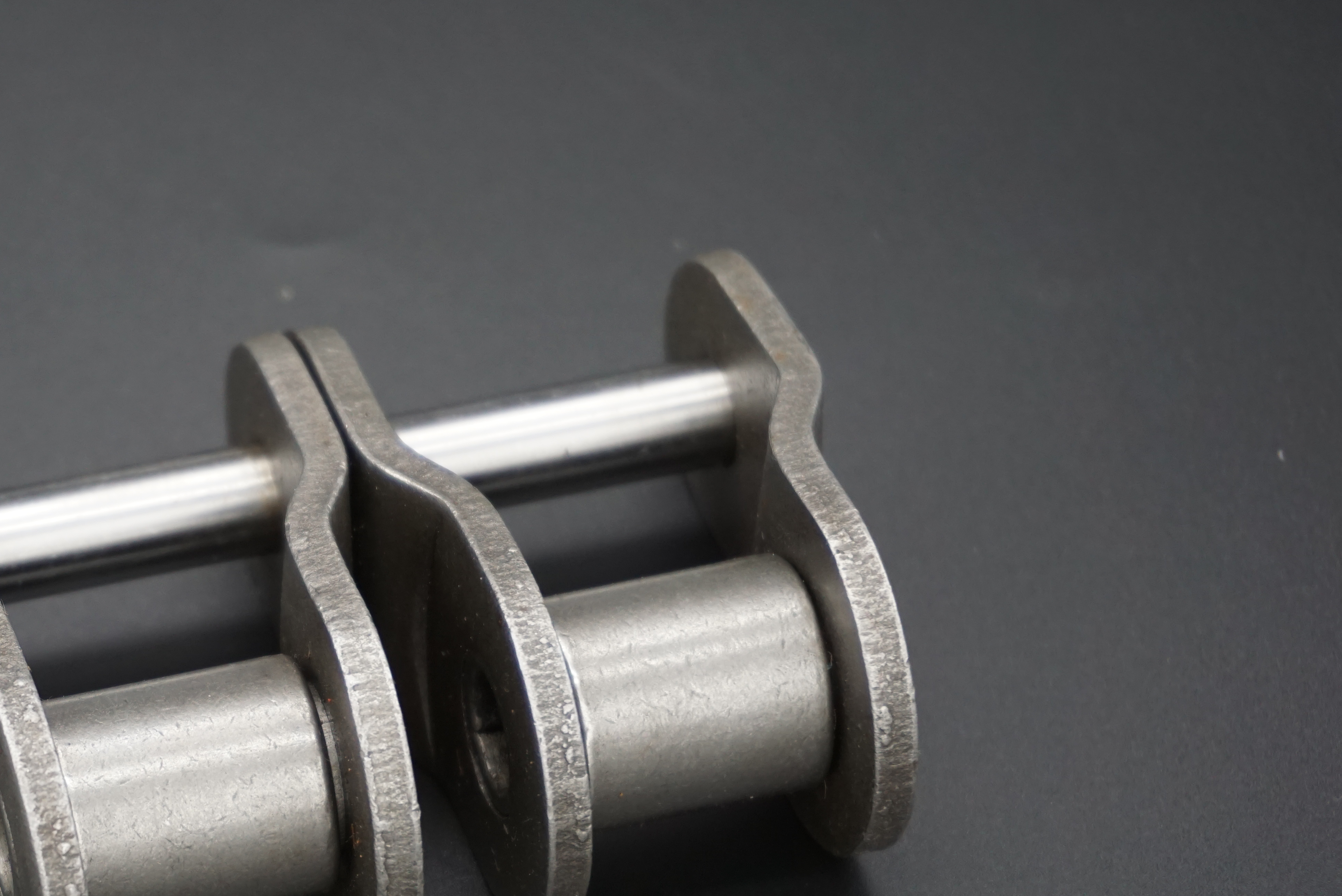
The Role of Heat Treatment
Heat treatment is what gives steel its working properties. For chain parts the objective is never “as hard as possible”. The objective is a controlled profile: a hard, wear-resistant surface over a tough, crack-resistant core. The sections below describe the main operations and the data you should ask a factory to provide.
Carburising and Carbonitriding
- Carburising introduces carbon into the surface layer of low-carbon steel parts such as pins and bushes, then quenches them to form a hard case over a ductile core.
- Carbonitriding adds nitrogen as well as carbon, which can improve surface hardness and resistance to scuffing, and is often used for smaller or thinner sections.
- The engineering point is the balance: a deep, hard case resists wear, while a tough core absorbs shock loads and resists fracture. A case that is too thick or too brittle defeats the purpose.
Quenching and Tempering
- Quenching locks in a hard martensitic structure but leaves the part internally stressed and brittle.
- Tempering is the controlled reheating that trades a little hardness for toughness and dimensional stability.
- The tempering temperature is the lever: higher tempering reduces hardness and increases toughness; lower tempering preserves hardness but keeps the part more brittle. The correct choice depends on which part you are treating and what load it sees.
Medium-Frequency Induction Hardening
- Induction hardening heats a targeted zone with an electromagnetic field and quenches it almost immediately, which suits plates and selected roller zones.
- Plates are typically hardened in the area around the holes where fatigue cracks begin, while rollers may be treated on the running surface that contacts the sprocket.
- The difference matters because a plate and a roller see different stress states; a single blanket process cannot be optimal for both.
How Hardness Is Expressed and What Case Depth Means
- Surface hardness is reported as Rockwell C (HRC) for general shop use or Vickers (HV) for thinner cases and laboratory measurement; the two scales describe the same property in different units.
- Case depth, sometimes reported per sample batch, tells you how far the hardened layer extends below the surface, which is the true indicator of wear reserve, not the surface number alone.
- A thin hard skin over a soft core will look good on a surface reading yet wear through quickly; the depth distribution is what predicts service life.
Common Heat Treatment Defects
- Decarburisation: loss of surface carbon during heating leaves a soft skin that wears fast.
- Overheating: excessive austenitising temperature produces coarse grain and low toughness.
- Quench cracking: from uneven cooling or excessive stress, often invisible until the part is loaded.
- Temper brittleness: improper tempering or slow cooling can make a hardened part fragile.
- Soft spots: localised untreated or under-treated areas that become early wear or failure points.
To judge a supplier, do not accept a single advertised hardness figure. Request the case-depth distribution and the hardness gradient from surface to core, matched to the drawing and the batch number, and compare the curve to the failure mode you care about. A factory that can show a consistent gradient across batches is more valuable than one that quotes a number on a brochure.
Pre-Stretching and Preloading
Many buyers believe a new chain “stretches” after installation. In reality the plates do not elongate; the apparent growth is the running-in of the pin and bush contact surfaces and the compaction of microscopic irregularities at the joint. Left untreated, this initial elongation happens on your machine during the first operating hours, when tension is uneven and alignment is still settling.
Pre-stretching, also called preloading, applies a defined tensile load at the factory so that the initial settlement occurs under controlled conditions before the chain ever reaches your line. The benefit is that the chain arrives closer to its stable length, which reduces early adjustment work and helps the drive settle quickly. It also reveals joints that would otherwise have seated poorly.
The effect on initial elongation is straightforward: a properly pre-stretched chain shows most of its break-in growth on the test bench, not on your conveyor. For the installer this means fewer re-tensioning cycles and less risk of the chain climbing or jumping a sprocket during commissioning. Pre-stretching quality is a process record, not a feeling: ask for the applied load and the measured residual elongation per batch.
Over-stretching damages the joint and reduces fatigue life; under-stretching leaves the running-in to happen in the field. Neither extreme helps. The correct load is a function of chain size, material, and intended duty, and it should be documented, not guessed.
Lubrication and the Initial Lubrication State
Chains leave the factory in one of two conditions: pre-lubricated at the works, or supplied dry for the user to lubricate. These are not interchangeable starting points. A factory-pre-lubricated chain is meant to run from installation with the lubricant already in the joints, which suits distributors who want a shelf-ready product and end users who may not relubricate immediately. A dry chain is intended for environments where a specific site lubricant must be introduced, or where the factory grease is incompatible with the application.
After pre-stretching the joints are open and clean, which is the ideal moment to introduce oil. Many suppliers perform an immersion or spin-off oiling step after pre-stretch: the chain is dipped and then spun so excess oil is removed and the retained film sits inside the joints rather than on the outer surface. The point is distribution into the articulating clearance, not the amount visible on the chain. Ask whether oiling follows pre-stretch and which viscosity grade is used, and match it to your operating temperature and speed rather than assuming one oil fits every duty.
Turning “Wear Life” from a Slogan into a Verifiable Requirement
“Long life” on a quotation is marketing. A verifiable requirement is a list of documents tied to a batch number. The data you should require from the factory includes material certificates for each component grade, the hardened-layer depth distribution, the hardness gradient from surface to core, the furnace temperature curve for the heat treatment lot, batch-level traceability, the pre-stretch load record, the post-stretch elongation record, and a breaking-load test report on sampled links.
On your side, the discipline is sampling and traceability. Keep the batch number from the certificate and link it to the physical coil you received. When a premature failure occurs, the batch record lets you ask a precise question instead of a vague complaint. Over time, correlating batch documents with field performance builds a supplier scorecard that no sales call can substitute for. Traceability is the bridge between a claim and a fact.
Field Verification Without Destructive Testing
You do not need laboratory equipment to catch obvious problems before installation. Simple, non-destructive checks on the bench can reject a bad lot or flag a chain for closer review.
- Inspect the outer surface and the plate edges for burrs, scoring, or irregular flash that suggests poor trimming or handling.
- Examine the pin ends: they should be uniform, seated, and free of cracks or uneven peening.
- Articulate a few joints by hand; they should rotate with consistent, light resistance rather than bind or feel loose.
- Check the marking and traceability on the packaging and the tag against the supplied certificate.
- Measure pitch, roller diameter, and plate dimensions with calipers and confirm interchangeability with the sprockets you run.
These checks are a supplement, not a replacement, for laboratory testing. They catch gross defects and shipping errors; they cannot measure case depth or verify a hardness gradient. Use them to screen, then rely on the documented batch data for the engineering decision.
Specification Checklist to Freeze in Your Inquiry
The following parameters should be fixed in writing before you request a quote, so that “same size” means the same thing to you and to the factory.
Parameters to Specify
- Chain type and standard, citing ANSI, ISO, or DIN as applicable to the market and sprockets in use.
- Component material grades for plate, pin, bush, and roller, with the relevant steel specification.
- Heat treatment method and the acceptance criteria for hardness and case depth, expressed as a required range and gradient rather than a single value.
- Pre-stretch requirement, including the applied load method and the maximum permitted residual elongation.
- Lubrication state at shipment: pre-lubricated or dry, and the oil grade if pre-lubricated.
- Dimensions and interchangeability tolerances, including pitch, roller diameter, and plate contour.
- Corrosion protection and surface treatment, such as zinc, nickel, Dacromet, or oil film, matched to the environment.
- Packaging and rust prevention for the transit and storage conditions you face.
- Batch number and full traceability from raw material to finished coil.
- Required document set: material certificates, heat treatment records, pre-stretch records, and test reports.
- Sampling plan for incoming inspection and the party responsible for test costs.
- Acceptance and rejection criteria, including what constitutes a non-conforming batch.
- Any attachment or special link configuration, defined by drawing rather than by description alone.
Common Procurement Mistakes and Supplier Audit Questions
Mistakes Buyers Repeatedly Make
- Specifying only the chain size and assuming all suppliers meet the same hidden process standard.
- Chasing the lowest unit price while ignoring heat treatment and pre-stretch documentation.
- Accepting a single advertised hardness number as proof of quality.
- Treating pre-lubricated and dry chains as interchangeable without checking the application.
- Skipping batch traceability, which makes root-cause analysis impossible after a failure.
- Buying on catalogue drawings alone and never requesting the furnace or pre-stretch records.
- Assuming one oil grade suits every speed, temperature, and contamination condition.
Questions to Ask a Supplier Before You Commit
- Which heat treatment process do you use for pins, bushes, rollers, and plates, and can you show the furnace curve for a recent lot?
- How do you measure and record case depth and the hardness gradient, and at what frequency?
- What pre-stretch load do you apply for this chain size, and do you record elongation per batch?
- What is your acceptance limit for residual elongation after pre-stretch?
- Are your chains pre-lubricated or dry at shipment, and what oil grade is used if pre-lubricated?
- What material certificates and test reports accompany each shipment, and in what language?
- How is batch traceability maintained from steel to finished coil, and can a failed link be traced back?
- What is your non-conformance process: replacement, credit, or eight-discipline investigation?
- Can you provide reference dimensions and interchangeability data for the sprockets in our market?
- What incoming inspection do you perform, and what sampling plan do you follow?
- How do you control decarburisation, quench cracking, and soft spots in production?
- What is your typical variation in case depth across a production run, and how is it monitored?
Frequently Asked Questions
Does a higher surface hardness always mean a longer-lasting chain?
No. Surface hardness is only one dimension of quality. A very hard but thin or brittle case can spall or crack, while a balanced case depth with a tough core often performs better in mixed wear and shock conditions. The useful measure is the hardness gradient and case depth, reviewed together with the application load. Always request the gradient rather than a single surface figure.
Is pre-stretching necessary for every roller chain application?
For most drive and conveyor chains supplied in volume, pre-stretching improves installation stability and reduces early adjustment, so it is worth specifying. For very short chains or special low-load duty it may be less critical, but the load should still be defined rather than omitted. The key is that the requirement is documented and the result is recorded per batch.
Can I verify chain quality without a laboratory?
You can screen for gross defects with visual, dimensional, and articulation checks, and you can review the supplier’s batch documents. Those steps catch shipping errors and obvious non-conformities. They do not replace measurement of case depth or hardness gradient, which require laboratory equipment. Use field checks to screen, and documented data to qualify.
Why do two chains of the same size fail at different times?
Because the size defines the geometry, not the process. Different heat treatment profiles, case depths, pre-stretch loads, and lubrication states produce different wear and fatigue behaviour even when the pitch and roller diameter are identical. Writing the process requirements into the specification is what removes the uncertainty between shipments.
Related Pages
- Key Factors Influencing Roller Chain Prices
- Maintenance Cost Comparison of Roller Chains and Chain Drives
- Selection of Standard and Non-Standard Roller Chains
- The Lifespan Advantage of Roller Chains vs Belt Drives
Tip: never accept a single advertised hardness number as proof of chain quality, because the surface reading alone hides the case depth and gradient that actually determine wear life.
Post time: Oct-23-2026