
Roller Chain Connecting Links: Cotter vs Spring Clip Specs
No roller chain assembly is stronger than the joint that closes it. The connecting link and the offset link are the two service components that turn a run of chain into an endless loop, and they are also the first places inspectors look when a drive fails unexpectedly. For equipment builders, dealers, and maintenance procurement teams, the choice between cotter pin retention and spring clip retention is a specification decision that affects vibration resistance, service speed, spare parts stocking, and warranty exposure.
Why Connecting Links Are the Weakest Point in an Endless Chain
A standard roller chain is built from alternating pin links and roller links, each assembled at the factory with interference-fit pins and riveted or staked ends. A connecting link, sometimes called a master link or detachable link, must be assembled in the field, which means its pins cannot be riveted. Retention depends entirely on a removable fastener: a cotter pin or a spring clip. An offset link, also called a half link, adds a bent plate to adjust length by one pitch, introducing extra bending stress on top of the weaker fastening.
Because of this, most chain engineers agree that a connecting link delivers roughly 80 to 90 percent of the base chain tensile strength, and an offset link closer to 70 to 80 percent. That number matters twice over: near-rated loads concentrate elongation and fatigue crack initiation at the detachable joint, and chains reported failed after only a few hundred hours fail at the joint far more often than anywhere else. Buyers who specify chains should treat detachable links as engineered wear components with a defined service life, not as permanent parts of the chain body.
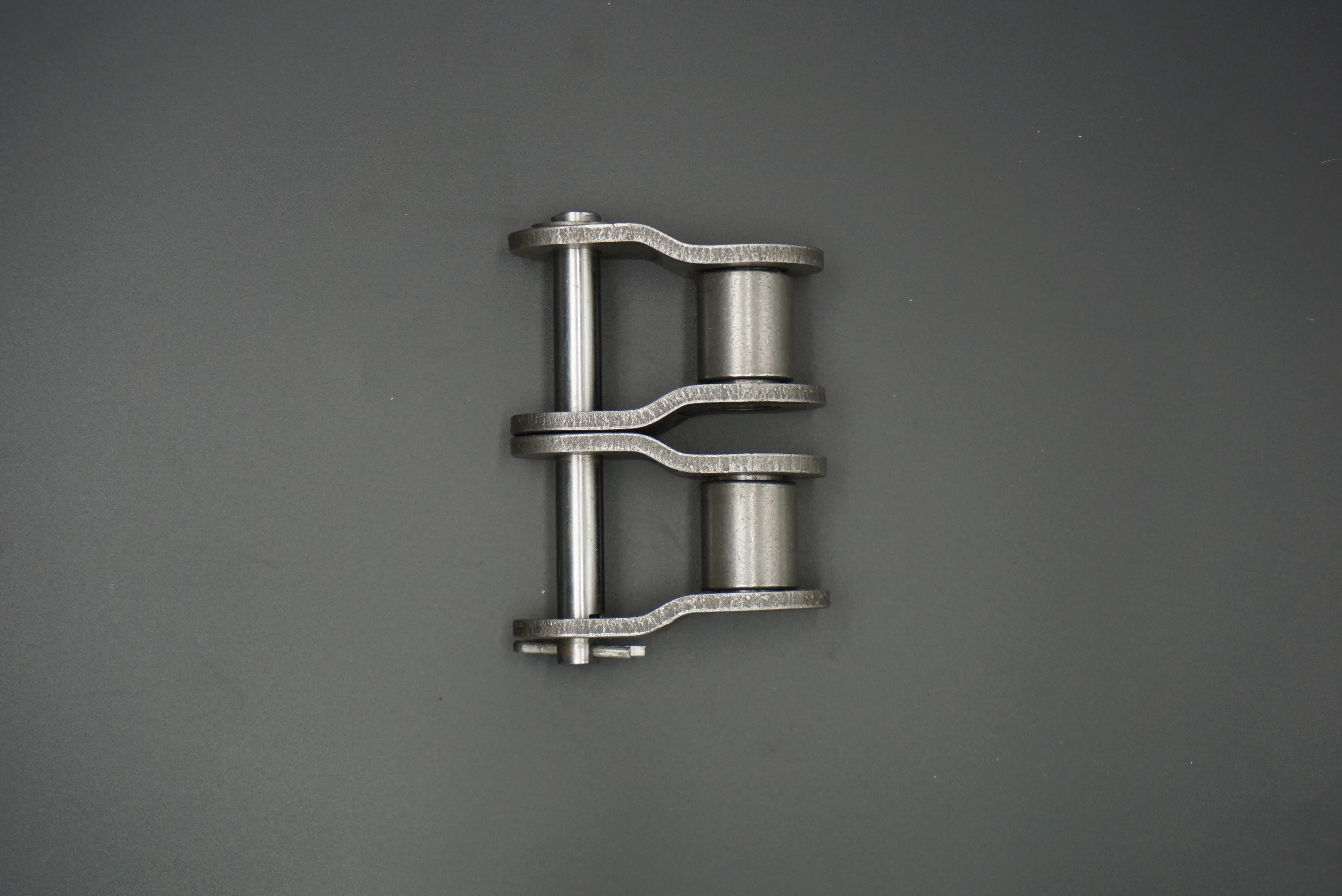
Cotter Pin vs Spring Clip: A Spec-by-Spec Comparison
Retention Force and Vibration Resistance
A cotter pin is a formed wire fastener pushed through a crosswise hole in the connecting pin, its legs then bent outward; once bent, it mechanically locks the pin against axial movement and resists vibration and shock far better than a clip. A spring clip, also called a master link clip, is a flat stamped spring steel part that snaps into grooves machined in the pin ends. Its retention comes from elastic spring force, typically a few hundred newtons per side.
In practical sourcing terms, cotter pins dominate on larger pitch chains where absolute retention matters, while spring clips dominate on smaller pitches where installation speed matters. As a working rule, spring clips are standard on ANSI 40 and smaller chains and common through ANSI 50, while cotter pins become the default from ANSI 60 upward and are essentially universal on ANSI 80 and larger, as well as on most BS/DIN chains from 08B upward under shock or vibration. Heavy series chains, engineering steel conveyor chains, and agricultural chains subject to impact loading almost always use cotter or even bolted lock rings instead of clips.
Installation and Removal Convenience
A spring clip can be installed in seconds with a pair of needle-nose pliers or a flat screwdriver, without disassembling the chain from the sprocket. This is why OEMs of light-duty equipment and conveyor maintenance crews favor clips for routine access. A cotter pin needs clearance around the pin end and both legs accessible for bending, but the tooling is still simple: pliers and a cotter bending tool. Removal reverses the story: a bent cotter must be straightened or cut and is single use, while a spring clip with intact temper can be reused a limited number of times, though replacement at every service is best practice.
Reusable or Not, and Cost Behavior
Cotter pins are consumables by design. Once bent, they should never be straightened and reused, because cold work embrittles the wire and the second bend rarely holds the same clench. Spring clips are cheap, but a fatigued clip loses tension silently, which is why planners order clips and cotters in bulk alongside chains. When comparing quotations, confirm whether connecting links are priced with cotter or clip, because the hardware and the failure consequences differ.
Press-Fit and Slip-Fit Connecting Pins
The second specification hidden inside every connecting link is the fit between the pin and the outer link plate. A press-fit connecting link has pins that are interference-fit into the outer plates at the factory. The plates cannot slide on the pins, so the joint carries load through the plate-pin interference rather than through the fastener alone, and its fatigue strength approaches that of a riveted pin link. The tradeoff is that installation requires pressing the plates on with a press or a dedicated jig, and field assembly under a machine is slow.
A slip-fit connecting link has pins that slide freely into the outer plate holes. Assembly takes seconds by hand, which is exactly what service technicians need when rejoining a chain on a conveyor bed. The tradeoff is lower fatigue strength, because the joint relies on the clip or cotter to keep the assembly together while the plates carry load through bearing contact only. The industry rule of thumb is that slip-fit links are acceptable for ANSI 40 and smaller light-duty drives and for low-speed conveyor service, while press-fit links should be specified for higher loads, higher speeds, multi-strand drives, and any application with reversing or shock loading. Some manufacturers publish a derating of around 20 percent on offset link ultimate strength, and slip-fit joints should be treated with a similar conservative margin.
Standards and Interchangeability: ANSI vs BS/DIN
ANSI B29.1 and the BS/DIN 8187 and 8188 families define pitch, roller diameter, plate height, and pin diameter for standard chains, and both families include dimensionally defined connecting links and offset links. An ANSI 40 chain has the same 12.7 mm pitch as a BS/DIN 08B, but the roller diameter, plate dimensions, and pin bores differ, so a BS/DIN 08B connecting link will not correctly fit an ANSI 40 chain even though the pitch matches. Mixing them produces a joint that either cannot seat or has destructive clearance.
Even within one standard family, cross-brand mixing of connecting links deserves caution. Pin groove positions for spring clips, cotter hole diameters, and clip thickness are manufacturer-specific details that standards do not fully control. A clip from brand A may seat loosely in brand B grooves, and a brand A cotter may rattle in a brand B hole. Interchangeability is guaranteed at the complete-link level only when the supplier certifies it. Always procure connecting links and offset links from the same manufacturer as the chain itself, or confirm in writing that the fastener geometry is dimensionally matched.
Installation Rules That Decide Joint Survival
- Cotter pin orientation and bending: Insert the cotter through the pin hole until the head seats, then bend both legs back against the pin body at roughly 60 to 90 degrees, one on each side. The legs must not protrude past the link plate profile where they can catch guards or fingers. Never reuse a bent cotter.
- Spring clip opening direction: The closed rounded end of the clip must lead and the open slotted end must trail relative to chain travel. In other words, the clip nose faces the direction of chain movement so any tendency to slide off is resisted by the stronger closed loop. Reversed clips are a classic root cause of lost links on conveyors.
- Tools: Use needle-nose pliers or a clip installation tool for spring clips, and a cotter bending tool or pliers for cotters. Hammering a clip on with a punch spreads the slots and destroys spring tension.
- Alignment and lubrication: Check that the connecting link plates sit flush with the rest of the chain, apply lubricant to the pin joint during assembly, and rotate the joint by hand to confirm free articulation before tensioning.
- Post-installation check: After the first hours of operation, re-inspect the joint, because clips seated on a burr often relax and freshly bent cotters must be confirmed fully bent.
Tip: A spring clip installed with its open end facing the direction of chain travel can walk off the pin grooves in a matter of hours, so verify clip orientation on every link during commissioning and after every maintenance intervention.
Failure Analysis: Reading a Failed Connecting Link
Field failures of connecting links fall into recognizable patterns, and each pattern points back to a specific selection or installation error. A link found separated with the clip missing and the pin grooves undamaged almost always indicates a reversed or fatigued clip, or a clip installed without full seating. A pin withdrawn with the cotter missing and an undamaged cotter hole suggests a reused or never-fully-bent cotter backing out under vibration. Gouged or scored pin ends point to a wrong-size or mismatched-brand fastener.
Fatigue fractures tell a different story. A crack initiating at the cotter hole in the pin, with a smooth beach-marked fracture surface, points to cyclic overload of a slip-fit joint that should have been press-fit, or to a drive running above its design load. A fracture through the offset plate of a half link, starting at the inner corner of the bend, indicates the offset link was used to correct a length that was actually off by a full pitch, or that shock loads exceed the derated capacity of the offset section. Comparing the failed hardware against the original specification, meaning clip groove dimensions, cotter diameter, and pin fit class, reveals whether the failure was an installation or a specification error, and that distinction determines whether the fix is training or re-specification.
Spare Parts Planning: How Many Connecting Links to Stock
Because connecting and offset links are the service interface of every chain, they should be stocked as a fixed ratio of chain purchases. A practical baseline is one connecting link per chain purchased plus 5 to 10 percent spares for service interventions, and one offset link per 5 to 10 chains, since half links are needed only when center distances are not a whole number of pitches. Dealers serving mixed fleets should also stock a small range of universal cotter pins and spring clips in bulk, because these fasteners are lost during repairs more often than they wear out.
For equipment maintenance packages, a practical kit includes the designated connecting links per machine, one offset link where drive geometry requires it, spare clips and cotters, and a printed installation card showing clip orientation and cotter bending. Bundling these into the preventive maintenance kit shortens downtime from hours to minutes and guarantees that the fasteners used in the field match the grooves the chain manufacturer dimensioned. Procurement teams should also record the chain brand and standard, ANSI or BS/DIN, on the spare parts list, so that reorder points trigger replacement links of the correct system.
FAQ
Can I use a spring clip on a large pitch chain if I do not have cotters?
No. Larger pitch chains, typically ANSI 60 and above, use cotter retention because clip spring force cannot reliably hold heavier pins under the higher masses and vibration of those drives. Substituting a clip from a smaller chain risks joint separation. Always keep the correct cotter size in stock for each large pitch chain you run.
How do I know whether my connecting link is press-fit or slip-fit?
Check whether the outer plate can be pushed onto the pins by hand. If it slides on easily, it is slip-fit. If it requires a press or a bench vise, it is press-fit. Catalog datasheets also state the fit class. If your application involves shock, reversing, or high-speed operation and your link is slip-fit, consult the chain manufacturer about upgrading to press-fit joints.
Are ANSI and BS/DIN connecting links interchangeable?
No. Even when pitches match, roller diameter, plate profile, and pin geometry differ between the ANSI B29.1 and BS/DIN 8187 and 8188 systems. An ANSI 40 connecting link will not correctly close a DIN 08B chain. Identify the chain standard before ordering any detachable link.
How many times can a spring clip be reused?
Treat clips as single-use consumables in critical drives. A clip can sometimes be reused once if it snaps firmly back onto the grooves with clear spring tension, but repeated removal relaxes the temper. Given the low cost of a clip relative to a thrown chain, replacement at every service is the economical policy.
Should offset links be avoided entirely?
Not entirely, but they should be minimized. Because the bent plate reduces joint strength by roughly 20 percent, use an offset link only when the center distance cannot be adjusted to a whole number of pitches. Where a half link is unavoidable, consider a two-pitch offset assembly with a press-fit connection.
The practical summary is simple: match the link to the chain standard, match the fastener to the load and vibration level, match the fastener geometry to the manufacturer, and stock detachable links as planned consumables rather than emergency purchases.
Related Pages
Key Factors Influencing Roller Chain Prices
Maintenance Cost Comparison of Roller Chains and Chain Drives
Selection of Standard and Non-Standard Roller Chains
The Lifespan Advantage of Roller Chains vs Belt Drives
Post time: Nov-04-2026