
How to Determine the Roller Chain Safety Factor
In industrial transmission systems, the roller chain’s safety factor directly determines the equipment’s operational stability, service life, and operator safety. Whether it’s heavy-duty transmission in mining machinery or precision conveying in automated production lines, incorrectly set safety factors can lead to premature chain breakage, equipment downtime, and even accidents. This article will systematically explain how to determine the roller chain’s safety factor, from basic concepts, key steps, influencing factors, to practical recommendations, to help engineers, purchasers, and equipment maintainers make accurate selection decisions.
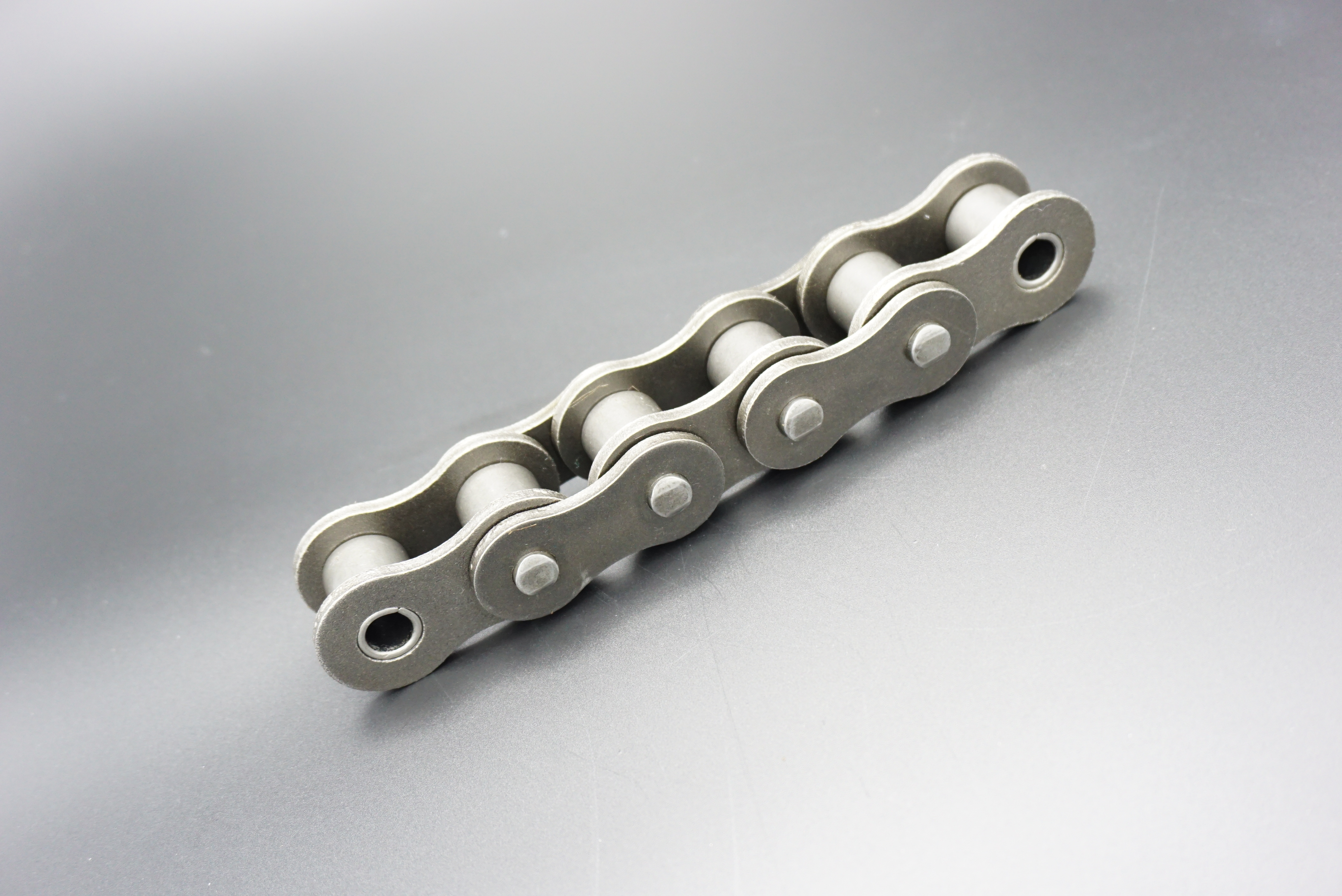
I. Basic Understanding of the Safety Factor: Why It’s the “Lifeline” of Roller Chain Selection
The safety factor (S.F.) is the ratio of a roller chain’s actual load-bearing capacity to its actual working load. Essentially, it provides a “safety margin” for chain operation. It not only offsets uncertainties such as load fluctuations and environmental interference, but also covers potential risks such as chain manufacturing errors and installation deviations. It is a key indicator for balancing safety and cost.
1.1 Core Definition of Safety Factor
The formula for calculating the safety factor is: Safety Factor (S.F.) = Roller Chain Rated Load Capacity (Fₙ) / Actual Working Load (F_w).
Rated load capacity (Fₙ): Determined by the chain manufacturer based on the material, structure (such as pitch and roller diameter), and manufacturing process, it typically includes the dynamic load rating (the load corresponding to fatigue life) and the static load rating (the load corresponding to instantaneous fracture). This can be found in product catalogs or in standards such as GB/T 1243 and ISO 606.
Actual Working Load (F_w): The maximum load a chain can withstand in actual operation. This factor takes into account factors such as starting shock, overload, and operating condition fluctuations, rather than simply a theoretically calculated load.
1.2 Industry Standards for Allowable Safety Factors
Safety factor requirements vary significantly across different application scenarios. Directly referring to the “allowable safety factor” specified by industry standards or by industry standards is essential to avoiding selection errors. The following is a reference for allowable safety factors for common operating conditions (based on GB/T 18150 and industrial practice):
II. 4-Step Core Process for Determining Roller Chain Safety Factors
Determining the safety factor isn’t a simple formula application; it requires a step-by-step breakdown based on actual operating conditions to ensure accurate and reliable load data at each step. The following process is applicable to most industrial roller chain applications.
Step 1: Determine the roller chain’s rated load capacity (Fₙ).
Prioritize obtaining data from the manufacturer’s product catalog. Pay attention to the “dynamic load rating” (usually corresponding to 1000 hours of fatigue life) and “static load rating” (corresponding to static tensile fracture) marked on the catalog. The two should be used separately (dynamic load rating for dynamic load conditions, static load rating for static load or low-speed conditions).
If sample data is missing, calculations can be made based on national standards. Taking GB/T 1243 as an example, the roller chain’s dynamic load rating (F₁) can be estimated using the formula: F₁ = 270 × (d₁)¹.⁸ (d₁ is the pin diameter, in mm). The static load rating (F₂) is approximately 3-5 times the dynamic load rating (depending on the material; 3 times for carbon steel and 5 times for alloy steel).
Correction for special operating conditions: If the chain operates in an ambient temperature exceeding 120°C, or if corrosion (such as in a chemical environment) is present, or if dust abrasion is present, the rated load capacity must be reduced. Generally, the load capacity is reduced by 10%-15% for every 100°C increase in temperature; in corrosive environments, the reduction is 20%-30%.
Step 2: Calculate the Actual Working Load (F_w)
The actual working load is the core variable in the safety factor calculation and should be comprehensively calculated based on the equipment type and operating conditions. Avoid using a “theoretical load” as a substitute. Determine the base load (F₀): Calculate the theoretical load based on the equipment’s intended use. For example, the base load of a conveyor chain = material weight + chain weight + conveyor belt weight (all calculated per meter); the base load of a drive chain = motor power × 9550 / (sprocket speed × transmission efficiency).
Superimposed Load Factor (K): This factor takes into account additional loads during actual operation. The formula is F_w = F₀ × K, where K is the combined load factor and should be selected based on the operating conditions:
Starting Shock Factor (K₁): 1.2-1.5 for soft-start equipment and 1.5-2.5 for direct-start equipment.
Overload Factor (K₂): 1.0-1.2 for continuous stable operation and 1.2-1.8 for intermittent overload (e.g., crusher).
Operating Condition Factor (K₃): 1.0 for clean and dry environments, 1.1-1.3 for humid and dusty environments, and 1.3-1.5 for corrosive environments.
Combined Load Factor K = K₁ × K₂ × K₃. For example, for a direct-start mining conveyor belt, K = 2.0 (K₁) × 1.5 (K₂) × 1.2 (K₃) = 3.6.
Post time: Oct-27-2025