
Economic Analysis of Roller Chain Selection
In industrial transmission systems, roller chains, as a core component combining reliability and adaptability, are widely used in various fields such as machinery manufacturing, agricultural equipment, and logistics transportation. When selecting roller chains, companies often fall into the trap of “price-only” selection—believing that the lower the initial purchase cost, the more economical it is, while ignoring the hidden expenses such as downtime losses, soaring maintenance costs, and energy waste that may result from improper selection. True economic selection focuses on moving beyond a single cost dimension and using “Life Cycle Value (LCC)” as the core to achieve optimal cost throughout the entire process of procurement, use, and maintenance. This article will break down the core of economic efficiency in roller chain selection from three levels: selection logic, key influencing factors, and practical principles.
I. The Underlying Logic of Economic Selection: Escaping the “Initial Cost” Trap
The “economic efficiency” of roller chains is not simply about the purchase price, but a comprehensive calculation of “initial investment + operating costs + hidden losses.” Many companies choose low-priced supply chains to control short-term costs, but face a high replacement frequency of “every three months,” coupled with production line shutdowns due to maintenance and increased labor costs, ultimately resulting in total expenditures far exceeding those of high-quality supply chains.
Taking an auto parts processing plant as an example: A non-standard roller chain purchased at 800 yuan has an average lifespan of only 6 months, requiring replacement twice a year. Each maintenance downtime is 4 hours. Based on a production line hourly output value of 5000 yuan, the annual hidden loss reaches 40,000 yuan (including maintenance labor and downtime output loss), with a total annual investment of 800×2+40000=41600 yuan. In contrast, choosing a high-quality roller chain conforming to DIN standards, with an initial purchase price of 1500 yuan, a lifespan of 24 months, requiring only one maintenance per year and 2 hours of downtime, results in a total annual investment of 1500÷2+20000=20750 yuan. The overall cost reduction over two years is more than 50%.
Therefore, the core issue in selection is not “expensive versus cheap,” but rather the balance between “short-term investment” and “long-term value.” Total Life Cycle Cost (LCC) = Initial Purchase Cost + Installation Cost + Maintenance Cost + Downtime Loss + Energy Cost + Disposal Cost. Only by selecting a chain based on this formula can true economic efficiency be maximized.
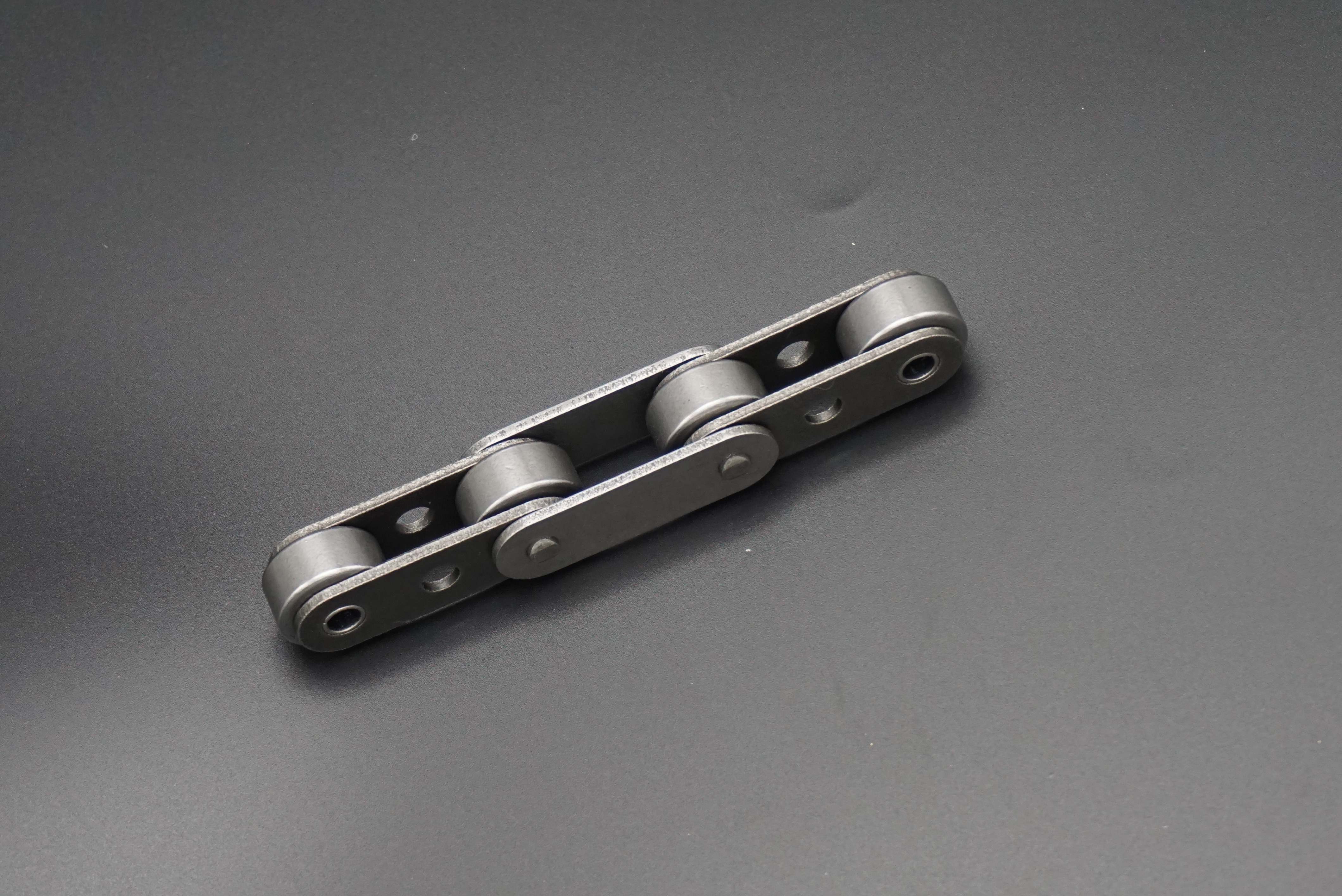
II. Four Core Factors Affecting the Economic Efficiency of Chain Selection
1. Precise Matching of Load and Strength: Avoiding “Over-design” and “Under-design” The strength of the roller chain must be strictly matched with the actual load; this is the foundation of economic efficiency. Blindly pursuing “high strength” and selecting a chain model far exceeding actual needs (e.g., selecting a chain with a rated load of 100kN for an actual load of 50kN) will increase purchase costs by more than 30%. Simultaneously, the increased chain weight will increase transmission resistance, leading to an 8%-12% increase in annual energy consumption. Conversely, selecting an insufficiently strong chain will result in fatigue fracture, excessively rapid chain link wear, and the loss of output value for every hour of downtime may be equivalent to several times the purchase price of the chain itself.
When selecting a model, it is necessary to calculate the safety factor based on the strength classification of international standards (such as DIN, ASIN) and parameters such as rated load, impact load, and instantaneous peak load under actual working conditions (a safety factor of ≥1.5 is recommended for industrial scenarios and ≥2.0 for heavy-duty scenarios). For example, the 12A series roller chain (pitch 19.05mm) is suitable for medium-load transmission, while the 16A series (pitch 25.4mm) is suitable for heavy-duty scenarios. Precise matching can control initial costs and avoid hidden losses caused by insufficient strength.
2. Working Condition Adaptation: Tailored Material and Structure Selection Different working conditions place significantly different requirements on the material and structure of roller chains. Ignoring the characteristics of the working conditions during selection will directly shorten the chain’s lifespan and increase maintenance costs: For ordinary working conditions (normal temperature, dry, light to medium load): carbon steel roller chains are sufficient, offering the best cost-performance ratio, low initial purchase cost, simple maintenance, and a service life of 1-2 years; For corrosive/humid working conditions (chemical, food processing, outdoor equipment): stainless steel roller chains or chains with surface anti-corrosion treatment (galvanized, chrome-plated) are required. The initial purchase price of these chains is 20%-40% higher than that of carbon steel chains, but their service life can be extended by 3-5 times, avoiding downtime losses and labor costs caused by frequent replacements.
For high-temperature/dust conditions (metallurgy, building materials, mining): roller chains made of high-temperature resistant alloys or with sealed structures should be selected. The sealed design reduces dust entering the chain link gaps, lowers the wear rate, extends the maintenance cycle from 3 months to 12 months, and reduces annual maintenance costs by more than 60%.
For long-distance conveying conditions (logistics sorting, agricultural machinery): Double-pitch conveyor chains are a more economical choice. They have a larger pitch, lighter weight, lower transmission resistance, 15% lower energy consumption than ordinary roller chains, more even load distribution, and a 20% longer lifespan.
3. Gear Ratio Design and Transmission Efficiency: Hidden Energy Costs
The gear ratio matching between the roller chain and the sprocket directly affects the transmission efficiency, and efficiency losses ultimately translate into energy costs. An improper gear ratio design (such as a mismatch between chain pitch and sprocket tooth count) can lead to poor meshing, increased sliding friction, and a 5%-10% reduction in transmission efficiency. For a 15kW device operating for 8000 hours annually, each 1% decrease in efficiency results in an additional 1200kWh of electricity consumption per year. At an industrial electricity price of 0.8 yuan/kWh, this translates to an extra 960 yuan annually.
When selecting a sprocket, the “gear ratio design principle” should be followed: the sprocket tooth count should ideally be between 17 and 60 teeth to avoid excessive chain wear due to too few teeth or increased transmission resistance due to too many teeth. Simultaneously, choosing a roller chain with high tooth profile precision and small pitch error (such as the A-series short-pitch precision double-link roller chain) can improve meshing accuracy, stabilizing transmission efficiency above 95%, and significantly reducing energy costs in the long run.
4. Ease of Maintenance: The “Hidden Benefit” of Reduced Downtime Downtime for maintenance is a “cost black hole” in industrial production, and the structural design of roller chains directly impacts maintenance efficiency. For example, roller chains with offset links allow for quick chain length adjustments, reducing disassembly and assembly time, and shortening a single maintenance session from 2 hours to 30 minutes. Furthermore, modular chain link designs eliminate the need for complete chain replacement; only worn links need to be replaced, reducing maintenance costs by 70%.
In addition, the versatility of wear parts must be considered: choosing roller chains that conform to international standards allows for convenient global procurement of wear parts such as links, rollers, and pins, avoiding prolonged downtime due to parts shortages. OEM/ODM customization services offered by some brands can further optimize the chain structure according to equipment requirements, further enhancing ease of maintenance.
III. Three Common Misconceptions in Selecting Chains for Economic Efficiency, Falling into the Trap of 90% of Enterprises
1. Blindly Pursuing Low Prices: Ignoring Standards and Compliance
Low-priced non-standard roller chains often cut corners in materials (using inferior carbon steel) and processes (substandard heat treatment). Although the initial purchase cost is 30%-50% lower, the lifespan is only 1/3 of that of a standard chain, and they are prone to breakage, jamming, and other malfunctions, leading to sudden production line shutdowns. The losses from a single downtime can far exceed the chain’s purchase price.
2. Over-Designing: Pursuing “Oversized” Strength
Some enterprises, for “safety’s sake,” blindly choose chains with loads far exceeding actual capabilities. This not only increases purchase costs but also leads to increased energy consumption due to the chain’s excessive weight and transmission resistance, ultimately driving up operating costs in the long run.
3. Ignoring Maintenance Costs: Focusing Only on “Affordability,” Not “Maintenance”
Failure to consider ease of maintenance and the difficulty of procuring spare parts during selection results in time-consuming and costly maintenance later on. For example, a mining company used a niche roller chain specification. After wear and tear, it had to order replacement parts from overseas, with a waiting period of up to one month, directly causing production line shutdowns and significant losses.
IV. Practical Principles for Economical Selection of Roller Chains
Data-Driven Selection: Clearly define core parameters such as rated load, speed, temperature, humidity, and corrosive environment in actual working conditions. Combine this with equipment manual calculations to determine the required chain strength, pitch, and material requirements, avoiding selection based on experience.
Prioritize International Standards: Select roller chains that conform to international standards such as DIN and ASIN to ensure that materials, processes, and precision meet standards, guaranteeing service life and reliability, while also facilitating the procurement of wear parts.
Calculate Total Life Cycle Cost: Compare the initial purchase cost, maintenance cycle, energy consumption, and downtime losses of different chains, selecting the option with the lowest LCC, rather than simply looking at the purchase price.
Customized Adaptation for Working Conditions: For special working conditions (such as high temperature, corrosion, and long-distance transportation), select customized solutions (such as special materials, sealing structures, and optimized gear ratios) to avoid performance redundancy or inadequacy of general-purpose chains.
Post time: Dec-29-2025